linda@xydishrack.com
+86-13431729140
86-750-6338203

Ordering dish racks in volume is never just about style, finish, or unit cost. The real decision is whether the product can stay consistent across every carton, every shipment, and every sales season. When a rack looks fine in one sample but performs poorly in storage, transport, or daily use, the cost appears later through returns, rust claims, unstable structure, and packaging damage. That is why dish rack quality should be judged with a repeatable inspection process before mass production starts.
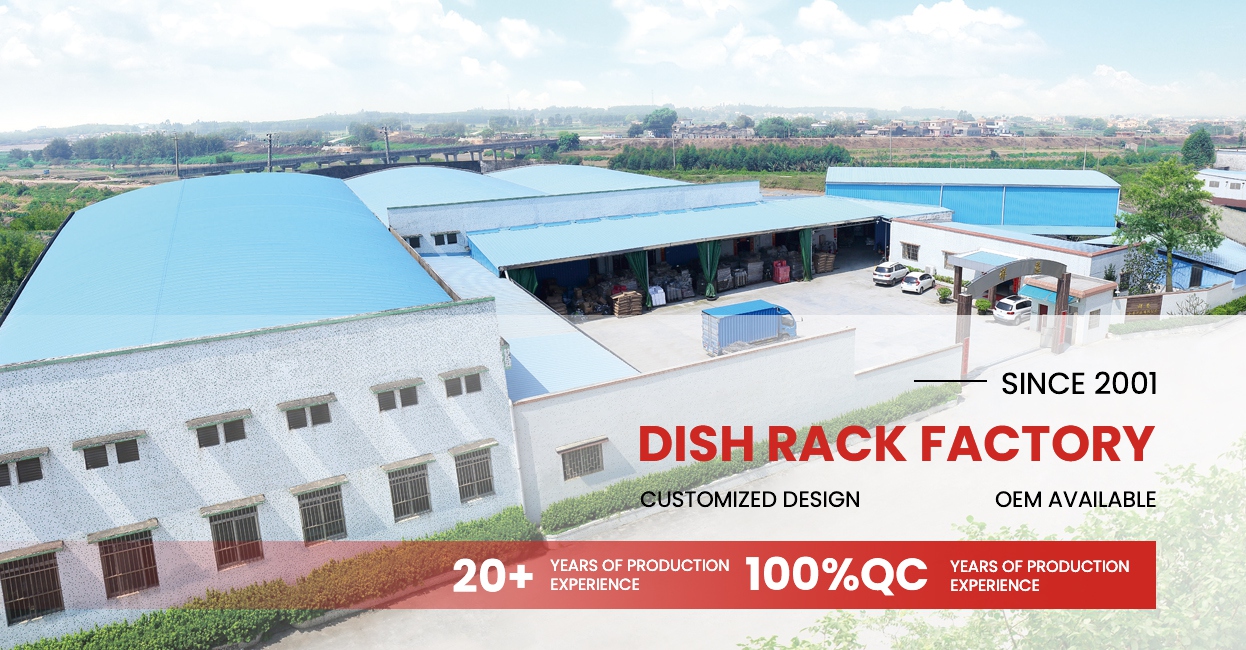
For buyers planning a large program, the best approach is to review the product from four angles at the same time: material, structure, surface treatment, and production consistency. XIANGYU has been focused on dish rack manufacturing since 2001 and presents itself as a manufacturer of iron, aluminum, and Stainless Steel Dish Racks with OEM capability. The company website also states a 6,000 square meter factory, around 100 employees, and a product range that covers multiple rack categories, which gives buyers a broader base for model development and order execution.
A reliable inspection should begin with the raw material itself. Ask for the exact metal grade, wire diameter, tube thickness, and tray specification before reviewing appearance. For projects that require a stainless steel dish rack with tray, buyers should confirm whether visible load-bearing parts and water-contact areas use the promised stainless grade and whether the tray material can resist deformation during long-term drainage use. For coated iron models, coating adhesion and substrate cleanliness matter as much as the metal base, because poor pretreatment often causes early rust at weld joints and bent corners.
A good supplier should also be able to explain how each material is matched to the intended retail price, market channel, and expected service life. This is especially important in OEM kitchen products, where the same shape may be offered in several cost levels. Material transparency reduces disputes later because the inspection standard is defined before the order enters full production. XIANGYU states that customized production is available across its main product lines, which is helpful when a project needs different material solutions for different markets.
Many buyers approve a sample too quickly because the rack looks clean and modern. In practice, metal rack quality is often revealed by stability tests. The rack should sit flat on the countertop without rocking. Weld points should be even and complete. Joints should not open when the rack is loaded with plates, bowls, and wet utensils. If the model is detachable, repeated assembly should not create looseness, sharp friction, or misalignment between tiers.
This is where a practical kitchen rack inspection routine helps. Test the rack under simulated use, not just visual review. Place a realistic mixed load on each level, then check tilt, tray fit, water flow path, and foot grip. Remove and reinstall detachable parts several times. Slide trays in and out. Inspect edge finishing by hand to confirm there are no burrs or unsafe corners. A factory that understands bulk delivery should be able to turn these actions into a standard internal quality flow rather than treating them as random sample checks.
Surface finish directly affects both shelf appeal and complaint rate. Chrome plated, painted, powder-coated, and stainless products each need different inspection priorities, but all of them must show uniform coverage, stable color, and clean weld transitions. Rust often starts where coating is thinnest, where water accumulates, or where pretreatment was incomplete. For this reason, buyers should request coating information together with corrosion test details rather than judging the product only by visual shine.
Salt spray testing is widely used as a quality control tool for coated metal products under ASTM B117, while ISO 9227 states that salt spray methods are useful for detecting discontinuities, pores, and damage in metallic and other coatings. These standards do not set one universal pass time for every product, but they provide a recognized framework for evaluating corrosion resistance. For kitchen-contact applications, NSF notes that NSF/ANSI 51 establishes minimum sanitation and material requirements for food equipment materials and finishes, which is a useful reference point when reviewing cleanability and safety expectations.
Before confirming a large order, buyers can use the following dish rack quality checklist to keep evaluation objective.
| Inspection item | What to verify | Why it matters |
|---|---|---|
| Material spec | Grade, thickness, wire diameter, tray material | Prevents hidden cost-down changes |
| Weld quality | Smooth joints, full connection, no cracks | Supports load stability |
| Surface finish | Even coating, no exposed base metal, no peeling | Reduces rust risk |
| Structural balance | No rocking, no tilt under load | Improves daily usability |
| Drainage design | Tray fit, water flow direction, easy cleaning | Cuts after-sales complaints |
| Assembly consistency | Uniform parts and hole positions | Protects batch consistency |
| Packaging strength | Carton, inner protection, drop resistance | Lowers shipping damage |
One approved sample is not enough for a serious order. A useful bulk dish rack inspection guide should include sample approval, pilot run review, inline checks during production, and final random inspection before shipment. Buyers should compare several units from different cartons, not just one top sample from the sales team. Dimensions, coating tone, tray fit, logo position, and accessory count should remain stable across the batch.
This is also where manufacturer capability becomes important. XIANGYU highlights long industry experience, multiple dish rack categories, and in-house manufacturing orientation, which can support better coordination between development, production, and order control when a project moves from sample to repeat shipment. For large programs, that consistency is often more valuable than a small initial price difference.
The safest way to evaluate a dish rack before a bulk order is to inspect it like a long-term product program rather than a simple household item. Check the raw material honestly, test the structure under real load, review the finish with corrosion awareness, and verify that the supplier can repeat the same standard across the whole order. When these points are controlled early, buyers protect margin, brand reputation, and delivery performance at the same time.
If you are comparing models for your next project, XIANGYU can support product discussion, sample review, and manufacturing-based guidance for large-volume dish rack programs.